
Will AI Replace Data Analysts?
One of the most common questions in the data field today is:
“Are you afraid AI will replace you?”
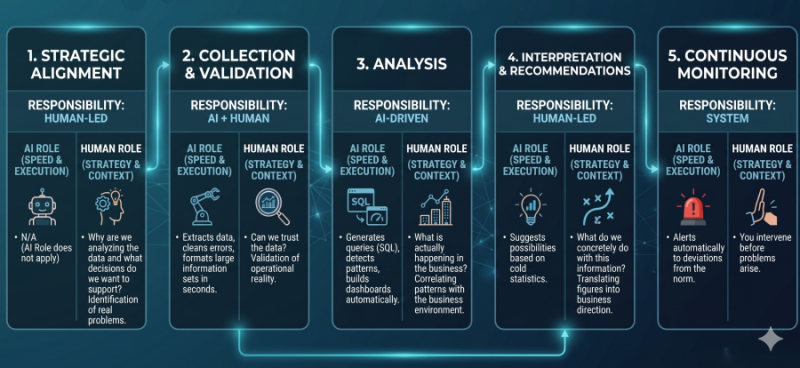
It is a valid question. AI tools can now generate SQL queries, build dashboards, summarize datasets, automate reports, and even explain trends in seconds.
From the outside, it may seem that the role of the data analyst is becoming obsolete.
But when we move beyond the headlines and examine how businesses actually operate, a different reality emerges:
AI is not replacing data analysts.
AI is changing what valuable analysts focus on.
And for companies whose mission is process improvement through data, this distinction is critical.
1. AI Is Automating Tasks — Not Business Understanding
Modern AI tools are extremely effective at accelerating repetitive activities:
- SQL generation
- Data cleaning assistance
- Dashboard creation
- Pattern detection
- Report summarization
This shift is real and already happening. But analysis is not only about producing outputs.
A business does not improve because a dashboard exists.
A business improves when someone understands:
- which problem matters,
- which variables influence it,
- what operational context exists,
- and what action should follow.
That layer still requires human judgment.
2. The Real Value of a Data Analyst
A strong data analyst does more than analyze numbers. They:
- understand business processes,
- identify operational inefficiencies,
- validate data quality,
- ask the right questions,
- challenge assumptions,
- and translate findings into decisions.
AI can generate possibilities.
Humans establish relevance. This distinction becomes even more important in process improvement environments where context, operational constraints, and stakeholder alignment matter as much as technical accuracy.
3. What Industry Experts Are Actually Saying
Many respected analysts and educators in the field, emphasize a similar direction:
The future of analytics is not human versus AI. It is human with AI.
Industry research also supports this perspective:
- Generative AI increases analyst productivity but still lacks contextual understanding and business reasoning.
- Analysts are shifting from manual reporting toward strategic interpretation and decision support.
- Companies increasingly value communication, business understanding, and process thinking alongside technical skills.
The repetitive part of the job is shrinking.
The strategic part is expanding.
4. AI Is a Powerful Accelerator — and Also a Risk
AI can dramatically increase execution speed. But speed without validation creates new risks:
- incorrect assumptions,
- hallucinated outputs,
- misleading correlations,
- inaccurate business conclusions.
An experienced analyst understands that:
- data quality matters,
- context matters,
- and interpretation matters.
AI can suggest an answer.
It cannot fully validate operational reality.
This is especially important in environments focused on:
- process optimization,
- operational efficiency,
- customer behavior,
- healthcare,
- finance,
- or strategic planning.
Wrong conclusions generated faster are still wrong conclusions.
5. The Analyst Role Is Evolving
The traditional analyst role focused heavily on:
- manual reporting,
- repetitive data extraction,
- dashboard maintenance.
AI is already reducing the time spent on these activities. The modern analyst increasingly focuses on:
- business understanding,
- decision support,
- process improvement,
- stakeholder communication,
- data governance,
- KPI design,
- strategic prioritization.
In other words: The analyst is moving closer to the business.
7. A More Realistic Perspective
Analysts who adapt to AI become significantly more effective than those who do not.
This has happened before:
- calculators did not eliminate finance,
- Excel did not eliminate accountants,
- BI tools did not eliminate analysts.
The tools evolved.
The expectations evolved.
The role evolved.
AI is another major evolution.
Key Takeaways
- AI is automating repetitive analytical tasks
- Human judgment and business context remain essential
- Process improvement requires interpretation, not only automation
- Analysts who learn to work with AI will become more valuable
- The future of analytics is collaborative, not competitive
AI will replace part of the way analysts work.
And that is not necessarily a threat.
When used correctly, AI allows analysts to spend less time producing reports and more time solving real business problems.
For organizations focused on process improvement through data, this matters even more.
Because sustainable improvement does not come from having more dashboards.
It comes from:
- asking better questions,
- understanding processes deeply,
- interpreting data correctly,
- and turning information into action.
AI can accelerate that journey. But it still takes people to lead it.
Related Posts
Don’t Ask for “Insights.” Ask for Answers to Specific Business Questions.
Many companies invest in data, dashboards, reporting tools, and analytics support—yet still feel disappointed by…
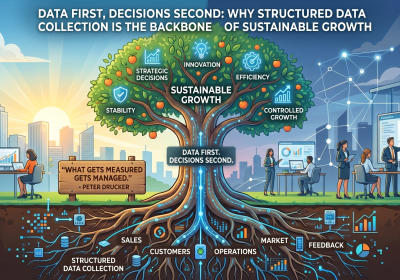
Data First, Decisions Second: Why Structured Data Collection Is the Backbone of Sustainable Growth
In any organization—whether a medical clinic, a service provider, or a community initiative—decisions shape outcomes.…

The Power of Data in Healthcare: Enhancing Medical, Operational, and Marketing Decisions
Power of Data in Healthcare, Personalized Patient Care, Operational Management, Improved Resource Management,Targeted Marketing Campaigns