
Don’t Ask for “Insights.” Ask for Answers to Specific Business Questions.
Many companies invest in data, dashboards, reporting tools, and analytics support—yet still feel disappointed by the results.
Why?
Because they often ask the wrong question.
A common request sounds like this:
“We have the data. Analyze it and tell us something interesting.”
At first glance, it seems reasonable. In practice, it usually leads to reports full of charts, trends, and observations that may be technically correct—but commercially irrelevant.
Data analysis creates value when it is connected to a specific business problem, not when it is treated as a generic exploration exercise.
This article explains why vague requests fail, how to ask better analytical questions, and how organizations can turn data teams into decision-making partners.
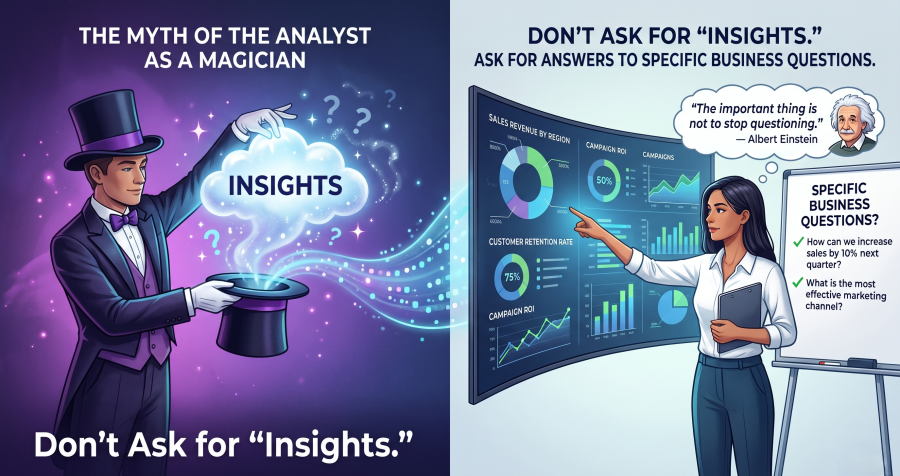
1. The Myth of the Analyst as a Magician
Some organizations still approach analytics as if the analyst can simply open a spreadsheet and uncover hidden profit opportunities automatically.
That is not how effective analysis works.
A strong data analyst is not a fortune teller. A data analyst is closer to a skilled investigator.
Without a clear objective, even the best analyst can only describe what is visible on the surface:
- Sales increased in March
- Region A performed better than Region B
- Product X had more transactions than Product Y
These facts may be accurate—but not useful.
Useful analysis starts with a business question that requires explanation, prioritization, or action.
2. Why Vague Requests Produce Weak Results
Typical Request
“We have three years of sales data. Analyze it and tell us what you find.”
Likely Outcome
- Attractive dashboards
- Trend charts
- Correlations without context
- Descriptive summaries
- No clear next action
The issue is not the analyst’s capability. The issue is lack of direction.
When the question is vague, the output becomes broad.
When the objective is unclear, recommendations become weak.
3. What Strong Requests Look Like
Better Business Request
“We need to understand why customer retention dropped by 5% last quarter in the northern region. We have sales data and customer feedback. Can you investigate the causes?”
Likely Outcome
- Segmented churn analysis
- Root cause hypotheses tested
- Service or pricing issues identified
- Comparison with previous periods
- Actionable recommendations
This type of request gives the analyst three critical elements:
- Problem – retention dropped
- Scope – northern region
- Timeframe – last quarter
Now analysis can move from observation to diagnosis.
4. The Detective Model of Data Analysis
Imagine a detective entering a room.
If you say:
“Look around and tell me something interesting.”
You may hear:
- The wall is white
- There are three chairs
- The window is open
All true. None decisive.
But if you say:
“Find out who stole the Ming vase between 3:00 and 4:00 AM.”
Now the detective knows:
- What matters
- What evidence to prioritize
- What to ignore
- Which timeline to reconstruct
- What answer is needed
The same applies to analytics.
Specific questions create focused investigations.
5. How to Ask Better Questions to Your Data Team
Before requesting analysis, define the following:
5.1 What Decision Needs to Be Made?
Examples:
- Should we reduce prices?
- Should we close a location?
- Should we invest more in region X?
If no decision is attached, the analysis may remain theoretical.
5.2 What Problem Are We Trying to Solve?
Examples:
- Declining retention
- Low conversion rates
- Rising operational costs
- Slower response times
Problems create relevance.
5.3 Where and When Is It Happening?
Examples:
- Last 90 days
- Southern region
- New customers only
- Mobile traffic segment
Scope prevents noise.
5.4 What Data Sources Exist?
Examples:
- CRM data
- Sales transactions
- Customer support tickets
- Survey feedback
- Website analytics
Good questions plus usable data create strong analysis.
Practical Examples: Weak vs Strong Requests
| Weak Request | Strong Request |
|---|---|
| Analyze our sales data | Why did sales decline 8% in Q1 for returning customers? |
| Look at website traffic | Why did conversion drop after the landing page redesign? |
| Tell us insights about customers | Which customer segment has highest churn risk and why? |
| Review operations data | Which process step causes most delays in delivery time? |
6. What Businesses Gain from Better Questions
When leaders ask precise analytical questions, they gain:
Faster Decisions
Less time reviewing irrelevant reports.
Higher ROI from Analytics
Analysts focus on business impact, not vanity metrics.
Clear Accountability
Problems become measurable and assignable.
Better Strategic Alignment
Analysis supports priorities, not curiosity alone.
7. The Role of Leadership
Strong analytics cultures are built by leaders who move conversations from:
- “Show me data”
to - “Help me solve this problem”
From:
- “What trends do you see?”
to - “Why is this KPI underperforming?”
From:
- “Tell me something interesting”
to - “What should we do next?”
That shift changes everything.
Key Takeaways
- Data analysis is most valuable when tied to a real business decision
- Vague requests produce broad outputs and weak recommendations
- Specific questions create focused, actionable analysis
- Analysts are problem-solvers, not mind readers
- Better questions generate better business outcomes
Do not ask your analyst for “insights.”
Ask for answers. Ask:
- Why did this happen?
- Where is the problem concentrated?
- Which customers are affected?
- What changed?
- What action should we test next?
Because data alone does not create value.
Well-defined questions do.
Related Posts
Data First, Decisions Second: Why Structured Data Collection Is the Backbone of Sustainable Growth
In any organization—whether a medical clinic, a service provider, or a community initiative—decisions shape outcomes.…

The Power of Data in Healthcare: Enhancing Medical, Operational, and Marketing Decisions
Power of Data in Healthcare, Personalized Patient Care, Operational Management, Improved Resource Management,Targeted Marketing Campaigns
How Toy Dispensers and Digital Walls are Revolutionizing Pediatric Care
children feel safe, happy, and eager to return, toy dispenser, digital wall